A Quick Note: I occasionally include affiliate links. As an Amazon Associate, I earn from qualifying purchases at no extra cost to you.
Is Your "Stress Hormone" Highjacking Your Life? High Cortisol Signs (and How to Fix It)
Feeling puffy, anxious, or "tired but wired"? Learn why cortisol and menopause symptoms are twins and get a 7-step plan to lower stress and build lean muscle.
12/17/202511 min read


Pull up a chair, grab a cozy blanket, and let’s talk about something that might be the "missing link" in your wellness journey.
Have you ever felt like you’re doing everything “right”? You’re eating the salads, you’re hitting the gym, you’re trying to get to bed early... but you still feel like a shell of yourself? Maybe you’re carrying extra weight around your midsection that won’t budge, or you’re lying wide awake at 3:00 AM with a racing mind, even though you were exhausted all day.
If you feel like your body has suddenly become a stranger to you, you aren’t alone.
You’re eating the same way you always have. You’re working out. You’re "doing the work." And yet, you wake up with a face that looks like you spent the night eating salt by the spoonful, your jeans won’t button over a new "spare tire" around your waist, and you have a sense of impending doom that makes a simple trip to the grocery store feel like a mission to Mars.
In the world of self improvement, we are often told to "push harder." But for the midlife woman, pushing harder is often the very thing keeping us stuck.
The culprit? Cortisol. Specifically, the way cortisol interacts with your changing hormones during perimenopause and menopause. This isn't just "stress"—it’s a biological hijacking. Today, we are going to break down why this happens and, more importantly, the exact, science-backed routines to bring your body back into balance.
Before we dive in, a quick note: I’m a wellness and growth advocate, not a doctor! The tips and supplements discussed here are based on my research into midlife health and my own personal journey. However, every body is unique—especially during menopause. Please chat with your physician or a functional medicine expert before adding things like Ashwagandha or Phosphatidylserine to your routine to ensure they are the right fit for your specific health needs.
What Exactly is Cortisol? (And why is it acting up now?)
Before we get into the signs, let's have a quick science minute. Cortisol is a steroid hormone produced by your adrenal glands. It’s often called the "fight or flight" hormone. In a perfect world, cortisol is your friend! It helps you wake up in the morning, regulates your blood pressure, and gives you a burst of energy if you need to run away from a literal bear.
The problem? Our modern brains can’t tell the difference between a bear and a passive-aggressive email from a boss or a mounting pile of holiday laundry.
The "Perfect Storm": Why Cortisol and Menopause are Biological Twins
Before we dive into the signs, we have to address the elephant in the room: Why does high cortisol look exactly like menopause?
You might be experiencing hot flashes, weight gain, brain fog, and anxiety, and your doctor tells you, "It’s just menopause." And they aren’t entirely wrong—but they’re missing half the story.
In midlife, cortisol and menopause symptoms are like identical twins. They look the same, they act the same, and they usually hang out together. Here is why:
1. The Pregnenolone Steal
Your body uses a "mother hormone" called pregnenolone to create both your sex hormones (estrogen and progesterone) and your stress hormones (cortisol). Under normal circumstances, there’s enough for everyone. But when you are chronically stressed, your body enters "survival mode." It "steals" the pregnenolone to make more cortisol, leaving almost nothing left to produce the estrogen and progesterone your body desperately needs during the menopause transition.
2. The Loss of Your "Natural Valium"
Progesterone is your body’s natural anti-anxiety agent. It helps you feel calm and sleep deeply. As we enter perimenopause, progesterone is usually the first hormone to drop. Without it, your "buffer" against cortisol is gone. A minor inconvenience that you would have brushed off at 30 now feels like a five-alarm fire at 45 because you no longer have the progesterone to dampen the stress response.
3. Shared Brain Real Estate
Estrogen and cortisol both compete for the attention of your hypothalamus (your brain's control center) and your hippocampus (your memory center). When estrogen drops, those areas of the brain become hypersensitive. This is why a "cortisol spike" in midlife causes much more damage to your mood and memory than it did a decade ago.
Understanding this is the first step in self improvement. You aren't "weak" or "lazy." Your biology has shifted, and your strategy must shift with it.
7 Signs Your Cortisol is Too High & How to Fix It
We’ve all heard the basic "you're tired" symptom, but high cortisol shows up in very specific, often frustrating ways for us. Let’s get into the specifics. We aren't just going to list the problems; we’re going to give you the "Self-Improvement" blueprint to solve them.
1. The Infamous "Cortisol Belly"
You know that stubborn layer of fat right around your midsection? The kind that feels different from the weight you’ve carried before? This fat feels "hard" or deep, rather than soft and jiggly.
The Science: Cortisol is an energy-mobilizing hormone. When you're stressed, it releases glucose for energy. If you don't use that energy (by literally fighting a tiger), your body stores it as visceral fat. Why the belly? Because abdominal fat cells have four times the amount of cortisol receptors compared to other fat cells.
The Fix: Lift Heavy and Anchor Meals with Protein
The 30g Rule: Eat 30–40g of protein within an hour of waking up. This stabilizes blood sugar and stops the "cortisol-insulin" spike that tells your body to store belly fat.
To master the '30g Rule' and protect your muscle mass, you need a high-quality, delicious protein. Clean Simple Eats is my absolute favorite for midlife wellness. It’s clean, macro-friendly, and tastes incredible—no 'protein' aftertaste here! It’s the easiest way to fuel your healthiest chapter."
Lift Heavy: Stop the long, slow cardio sessions that spike cortisol. Focus on 20–30 minutes of heavy resistance training. Building lean muscle is the only way to improve insulin sensitivity and "burn off" the cortisol-driven glucose.
2. The "Moon Face" (Systemic Puffiness)
The Sign: You wake up with a rounded, swollen appearance in your face (especially the cheeks and jawline). You might feel like your rings don't fit in the morning, or your eyes look "sunken" into puffy lids.
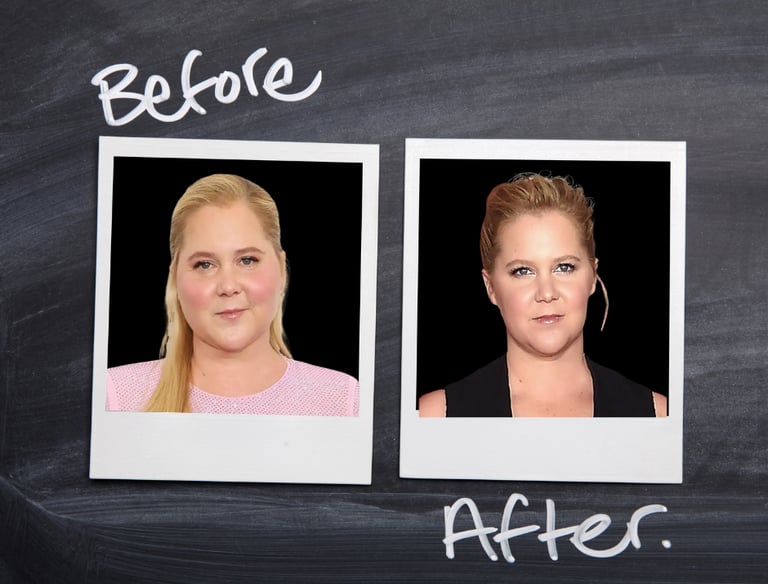
You may have seen this "before and after" of Amy Schumer circulating recently. Amy bravely shared that her noticeably rounded, puffy appearance was due to exogenous Cushing’s Syndrome—a condition caused by a massive overload of cortisol in the body.
While Amy’s case was medical, many midlife women experience a version of these hallmark signs: the rounded jawline, the fullness in the cheeks, and the way the eyes can appear slightly "lost" in the facial puffiness. This isn't "weight gain" in the traditional sense; it is your body’s response to a hormonal SOS. When cortisol is chronically high, your kidneys hang onto sodium and water, and your body redistributes fat to the face and neck. If you wake up feeling like your face "isn't yours," it’s time to look at your stress levels, not your calorie intake.
The Science: High cortisol levels cause your kidneys to hang onto sodium and dump potassium. This leads to intense water retention. It also causes a "redistribution" of fat to the face and the back of the neck (sometimes called a "buffalo hump").
The Fix: Mineral Balancing and Lymphatic Love
Stop Drinking "Naked" Water: If you are puffy, your cells aren't absorbing the water you drink; it’s just sitting in your tissues. Add a pinch of Celtic sea salt and a squeeze of lemon to your water, or use high-quality electrolyte drops.
The "Morning De-Puff Ritual: When cortisol has your face feeling heavy and rounded, you need to physically move that stagnant lymph fluid to see your jawline again. My go-to is the Kitsch Stainless Steel Gua Sha Facial Tool. I prefer stainless steel over traditional stone because it is naturally colder (which is an instant anti-inflammatory for 'moon face') and it’s non-porous, so it won’t harbor bacteria. Just two minutes of gentle outward and downward strokes helps flush out that cortisol-driven water retention and wakes up your complexion. Plus, unlike jade or quartz, it’s unbreakable—perfect for those clumsy 3:00 AM wake-up calls!
👉 Shop the Kitsch Stainless Steel Gua Sha Here
3. The "Tired but Wired" Paradox
The Sign: You are exhausted all day—feeling like you’re walking through mud—but the second your head hits the pillow at 10:00 PM, your brain turns into a 24-hour news cycle. Then, even if you fall asleep, you’re awake at 3:00 AM with a mind that won't shut off.
The Science: Your cortisol rhythm is inverted. Normally, cortisol should be high in the morning (to wake you up) and low at night (to let you sleep). Chronic stress flips this, giving you "flat" morning cortisol and a "spike" at night. The 3 AM wake-up is often a "liver dump"—your blood sugar drops, and your body releases cortisol to bring it back up, which jolts you awake.
The Fix:The "Bedtime Anchor" and Sun-Syncing
The Morning Routine: Get 10 minutes of direct sunlight (no sunglasses) in your eyes within 30 minutes of waking. This triggers the natural peak of cortisol when it should happen, which helps time the "dip" for 14 hours later.
The Night Routine: Wear blue-light-blocking glasses after 7:00 PM. Blue light from your phone tells your brain it's noon, which triggers a cortisol spike that kills your melatonin production.
The Anchor Snack: Have one tablespoon of almond butter or a small piece of turkey before bed. The protein and fat keep your blood sugar stable, preventing that 3 AM cortisol surge.
The Ultimate Nighttime 'Chill' Ritual: If you’re stuck in the 'tired but wired' loop, your nervous system is likely screaming for magnesium. But not all magnesium is created equal. I’ve recently added PYM Mood Magnesium Powder to my evening routine, and it has been a game-changer for those 3:00 AM wake-ups. It uses Magnesium Glycinate to calm the 'fight or flight' response and L-Threonate, which is the only form of magnesium that truly crosses the blood-brain barrier to quiet a racing mind. I mix a scoop into a little warm water before bed—it’s like a hug for your brain.
5. Intense Cravings for Sugar and Salt
The Sign: You don't just "want" a cookie; you feel like you need it for survival. You find yourself mindlessly snacking on salty chips or reaching for chocolate every afternoon at 3:00 PM.
The Science: When cortisol is high, your brain is in "survival mode." It wants the fastest form of energy possible (glucose/sugar). Furthermore, because high cortisol causes you to lose minerals through your urine, your body craves salt to try and regain balance.
The Fix: The "Smart Swap" and Ashwagandha
The Swap: Instead of reaching for processed sugar, have a "Sweet & Salty" combo that includes protein, like an apple with almond butter and sea salt.
The Supplement: This is where Ashwagandha shines. It is an adaptogen that "muffles" the stress signal from the brain to the adrenals.
When to take it: For most midlife women, the best time to take Ashwagandha (specifically the KSM-66 extract) is in the early evening (around 5:00 or 6:00 PM). This helps dampen the evening cortisol rise, allowing you to wind down for sleep. If you suffer from high anxiety all day, you can split the dose between morning and evening. Youtheory Ashwagandha is the one I trust. With a potent 1,000 mg dose per serving, it helps 'muffle' that frantic stress signal your brain sends out around 5:00 PM. I find that when I take this, I don't get that 'snappy' irritability while making dinner, and my evening sugar cravings are significantly lower. It’s like a volume knob for your internal alarm system."
👉 Shop Youtheory Ashwagandha Here
6. The "Doom" Feeling: Midlife Anxiety
The Sign: It’s not just a "busy mind." It’s an internal vibration, a tightness in the chest, and a feeling that "something bad is about to happen." You feel a sense of impending doom. Small things—like a loud noise or a cluttered kitchen—make you want to scream or cry. You feel hyper-vigilant, like you’re constantly waiting for the "other shoe to drop."
The Science: Prolonged high cortisol keeps your amygdala (the brain's smoke detector) enlarged and overactive. At the same time, it shrinks the prefrontal cortex (the rational, "calm down" part of the brain). You are physically losing your ability to rationalize your way out of stress.
The Fix: Meditation and Vagus Nerve Toning
The Meditation Routine: This is not about "clearing your mind" (which is impossible when cortisol is high). It is about re-training your nervous system.
Try Box Breathing: Inhale for 4, Hold for 4, Exhale for 4, Hold for 4. Repeat for 5 minutes. The long exhale is the "off switch" for the sympathetic nervous system.
When: Do this at "Transition Points"—when you pull into your driveway after work, or before you start cooking dinner.
Vagus Nerve Toning: Splash ice-cold water on your face for 30 seconds or hum loudly. Both of these stimulate the Vagus nerve, which sends an immediate "all clear" signal to the brain, forcing cortisol levels to drop.
8. The "Cotton Wool" Brain (Brain Fog)
The Sign: You walk into a room and forget why. You struggle to find common words, or you feel like your brain is "buffering" like a slow internet connection.
The Science: High cortisol is neurotoxic to the hippocampus, the part of your brain responsible for short-term memory and learning. While we often blame "menopause brain," cortisol is often the one actually pulling the plug on your focus.
The Fix: The "Clear Mind" Protocol
The Supplement Duo: To clear the fog, I recommend a two-pronged approach. First, use PYM Mood Magnesium Powder. Its L-Threonate is one of the only forms of magnesium that crosses the blood-brain barrier to quiet a frantic mind. Second, consider adding Phosphatidylserine. This phospholipid helps "blunt" the cortisol response in the brain, essentially putting a silencer on the stress signal so you can think clearly again.
The Meditation "Software Update": Meditation isn't just about "omming" away your stress; it’s actual self improvement for your gray matter. Science shows that just 5–10 minutes of daily meditation can actually help regrow the hippocampus and shrink the amygdala. It’s the ultimate "off-switch" for the brain fog loop.
Try this: Use a guided app like Insight Timer or simply focus on the sensation of your breath for 5 minutes before you start your workday.
The "Single-Tasking" Habit: Cortisol thrives on the frantic feeling of multitasking. Set a timer for 25 minutes and do one thing. It lowers the perceived "threat" to your brain and lets your supplements do their work.
👉 Clear the Fog with PYM Mood Magnesium 👉 Shop my favorite Phosphatidylserine for Memory Support
9. The "Shut Down" (Low Libido & Digestive Issues)
The Sign: You have zero interest in intimacy, and your digestion is a mess—bloating after every meal, or a stomach that feels "tied in knots."
The Science: This is a survival mechanism. When cortisol is high, your body enters Sympathetic Mode (Fight or Flight). In this state, your body thinks it’s being hunted. It intentionally shuts down "non-essential" systems like reproduction (libido) and digestion to save energy for survival. You can’t digest a kale salad or feel "in the mood" if your brain thinks you're running for your life.
The Fix: The "Rest and Digest" Ritual.
The 5-Breath Rule: Before you take your first bite of any meal, take 5 slow, deep breaths. This forces your body out of "fight" mode and into "digest" mode, allowing your stomach acid and enzymes to actually do their job.
Self-Care Essentials: Prioritize "low-stakes" pleasure. A warm bath with Epsom salts, a soft weighted blanket, or a cozy pair of slippers. These small "safety" signals tell your nervous system it's okay to turn the libido and digestion systems back on.
Making This Your Healthiest Chapter Yet
In our 20s, we thought self improvement was about doing more, being more, and pushing harder. In midlife, we know better.
In midlife, we are often at the peak of our responsibilities, but we have to remember that we cannot pour from an empty cup. By prioritizing these small, science-backed shifts—the high protein breakfast, the late-afternoon Ashwagandha, and the deep, belly breaths—you aren't just "managing stress." You are reclaiming your health, your metabolism, and your joy.
You’ve spent decades taking care of everyone else. It’s time to take care of the woman in the mirror.
Ready to take action? > Knowing the signs of high cortisol is powerful, but now it’s time to give your body the relief it deserves. I’ve taken the guesswork out of the process with my Step-by-Step 7-Day Cortisol Reset. This comprehensive guide includes my favorite sugar-free swaps, the "30g Protein Rule," and a free printable checklist to help you make this your healthiest chapter yet.
Connect
info@marvelouslymidlife.com
© 2025. All rights reserved.
DISCLAIMER: As an Amazon associate and affiliate for other brands, I earn commissions from qualifying purchases.