A Quick Note: I occasionally include affiliate links. As an Amazon Associate, I earn from qualifying purchases at no extra cost to you.
The Workout Routine To Actually Get That Muscle Mommy Look
Stop overtraining and start seeing results. Learn why the ultimate muscle mommy secret isn't just the gym—it's recovery. Pair your workout routine with intentional rest and high protein to erase midlife belly fat and build a body that thrives.
5/7/202610 min read
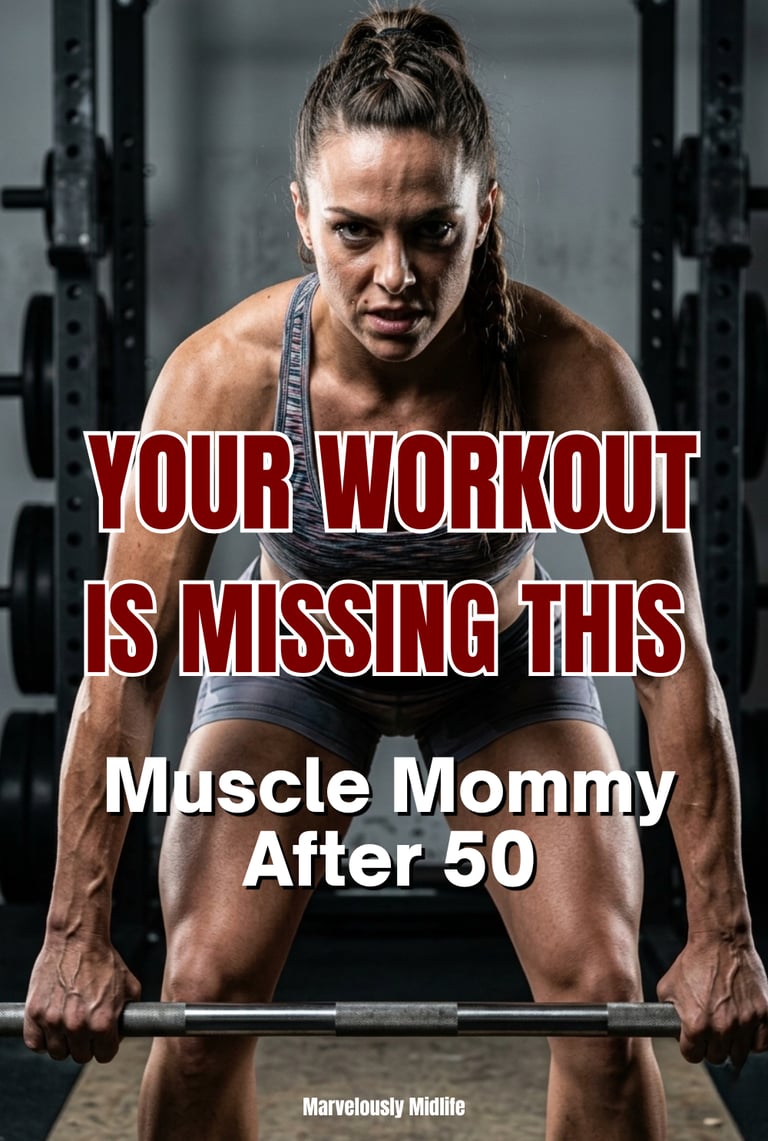
Ready to stop shrinking and start growing? 🛑 If you've been chasing a smaller version of yourself for decades and wondering why it stopped working, this is the post that's going to change everything. We're talking muscle building secrets for midlife women, the workout routines that build the muscle mommy aesthetic, and the real reason lifting heavy is the most powerful thing you can do for your body right now. 💪✨
Okay, real talk. For most of our lives, we were handed one playbook: eat less, move more, and cardio, cardio, cardio. And for a while? It kind of worked. A few extra spin classes after a holiday weekend and we were right back on track.
Then 40 hit. Then 45. And suddenly, the math just... stopped working.
The scale started creeping up even when nothing changed. The "skinny" we used to chase started looking like something else entirely, something softer and more tired than we wanted. And the cardio that used to fix everything? It felt like running on a hamster wheel going absolutely nowhere.
Here's what nobody told us. We were playing the wrong game the whole time.
We are officially swapping the goal of "weight loss" for the far more powerful goal of muscle building. And I'm going to walk you through everything, including what to eat, what supplements to take, how many steps to get, and the actual workout routine to build that strong, sculpted muscle mommy body you've been seeing all over your feed. 🏗️✨
Let's start with the fuel, because you can't build a house without materials.
Feed the Muscle First
Before we even talk about lifting, we need to talk about what goes in your body, because this is where most midlife women are quietly sabotaging themselves without even knowing it.
The Protein Problem
Here's something that shocked me when I first learned it. We actually need MORE protein now than we did in our 20s, not less. As we age, our bodies develop something called Anabolic Resistance, which basically means our muscles become harder to talk to. They don't respond to protein as efficiently as they used to. So the little bit of protein you used to eat? It's no longer doing the job.
The goal is to hit roughly 100 to 130 grams of protein per day, and here's the critical part: you can't just dump it all in one meal. You need to hit at least 25 to 30 grams of high-quality protein at every single meal. That threshold is what triggers Muscle Protein Synthesis, which is the process of actually building muscle tissue. Ten grams with an apple for breakfast isn't going to cut it, babe. You need the eggs, the Greek yogurt, the cottage cheese, or the protein shake. 🥚
I'll be honest, some days hitting that number from food alone feels like a part-time job. That's where protein powder becomes your best friend.
A high-quality whey protein powder is honestly one of the most practical tools in your muscle building kit. Whey is fast-digesting, which means your muscles can use it quickly, especially after a workout. It's also one of the highest-quality protein sources available because it contains all nine essential amino acids and is particularly rich in Leucine, which is the specific amino acid that acts as the "on switch" for muscle building.
Look for a whey protein that has at least 20 to 25 grams of protein per serving, a short ingredient list, and minimal added sugar. My personal picks lean toward clean, unflavored or lightly flavored options that I can blend into a smoothie, mix with Greek yogurt, or just shake up with water post-workout without feeling like I'm drinking a dessert.
👉Clean Simple Eats Whey Protein is my favorite and comes in yummy flavors.
Two scoops in a smoothie with some frozen fruit and almond milk? That's 50 grams of protein with basically zero effort. 🥤
Supplement #2: Creatine Monohydrate
Okay, I need you to hear me out on this one, because creatine has a reputation problem that it absolutely does not deserve. 🙄
The myth that creatine makes you puffy and bloated and bulky? That's outdated information based on the old "loading phase" method that bodybuilders used to do. For us, taking a small, consistent daily dose doesn't look anything like that.
What creatine actually does is give your muscle cells more energy to work with during intense exercise. Think of it like a battery pack for your muscles. It helps you eke out those extra reps at the end of a hard set, which is exactly where muscle growth happens. It also helps you hold onto lean mass, which is the whole point.
Here's the bonus that nobody talks about enough: creatine is showing serious promise for brain health and cognitive function in women, particularly around and after menopause. Menopause brain fog is absolutely real, and the emerging research on creatine's impact on memory and mental clarity in women? Pretty exciting.
You want plain Creatine Monohydrate, not the fancy "HCL" or "advanced" versions. Those are just marketing. My go-to is Momentous Creatine Monohydrate, which is micronized so it dissolves completely and you'll never know it's in your water. Three to five grams a day, every day, even rest days. Done.
👉Momentous Creatine Monohydrate
Supplement #3: Essential Amino Acids (EAAs)
Think of protein like a beaded necklace. The beads are amino acids, and there are 20 of them total. Nine of those are "essential," meaning your body can't make them on its own. You have to eat them.
One of those nine, called Leucine, is the specific trigger for muscle building. In midlife, because of that Anabolic Resistance we talked about, you need a bigger dose of Leucine to flip the switch than you did in your 20s.
You might have heard of BCAAs, but EAAs are the upgrade. BCAAs only give you three of the nine amino acids. EAAs give you the full picture. Sip on them during or right after your workout and you're giving your muscles exactly what they need to start repairing and growing immediately.
Look for an EAA powder with at least 2.5 to 3 grams of Leucine per serving and a clean ingredient list. Kion Aminos, Thorne Amino Complex, and Transparent Labs all make solid options.
👉 Kion Aminos (this is the one I use and love)
The Cardio Truth... Why You Can't Run Your Way Out of This
Before we get to the workout routine, I need to address the cardio elephant in the room. 🐘
Starting around age 30, we naturally begin losing muscle mass in a process called sarcopenia, about 3 to 5 percent per decade. Then perimenopause and menopause hit, and it accelerates. Estrogen, which was quietly acting as an anabolic hormone keeping our muscles strong and our metabolism humming, starts to drop. And when it does, three things happen that none of us signed up for: muscle wasting speeds up, fat redistributes from the hips to the visceral belly area, and we become more insulin resistant.
Cardio burns calories while you're doing it. That's it. It doesn't build the metabolic engine that keeps you burning calories at rest. Muscle does that. The more lean muscle you have on your body, the more calories you burn just existing, sleeping, watching Netflix, doing absolutely nothing. Muscle is metabolically expensive to maintain, and that is exactly the kind of expensive we want to be. 😂
This doesn't mean cardio is evil. Walking especially is genuinely wonderful for you, and we're going to talk about that in a second. But we're done with the idea that cardio alone is going to give us the body we want in midlife. It's not. Lifting is.
Walk Your Way to 15,000 Steps
Before you skip this section because you think walking is boring, stay with me. 🚶♀️
Walking is low-impact, joint-friendly, and one of the most underrated tools for fat loss in midlife, especially when you combine it with a solid strength training routine. It doesn't spike cortisol the way intense cardio can, and elevated cortisol is exactly what we're trying to avoid because it actively works against muscle building and fat loss.
The goal I'd encourage you to work toward is 15,000 steps per day. Now before that sounds scary, most people average somewhere between 5,000 and 7,000, so this is a gradual build, not an overnight overhaul.
Here's roughly what that looks like in terms of calories burned: depending on your weight and pace, 10,000 steps burns somewhere in the range of 300 to 400 calories. Getting to 15,000 steps can push that to 450 to 600 calories burned per day from walking alone. Over the course of a week, that adds up to a very meaningful calorie deficit without doing a single HIIT class or destroying your joints. 🔥
The trick is making it easy. And this is where I'm obsessed with my walking pad.
If you haven't discovered the walking pad yet, it's basically a flat, slim treadmill that sits under your desk or in front of your couch. I use mine while I'm answering emails, watching TV, or even on video calls (though I keep the speed pretty slow for that one 😅). It's genuinely changed how I get my steps in because I'm not relying on willpower or good weather. I just step on and walk.
This is the walking pad I use and love. It folds up flat, it's quiet enough for calls, and it doesn't require rearranging your whole house to fit it. If you're serious about building that muscle mommy body, hitting your daily steps is the cardio layer that works with your lifting routine, not against it.
Start where you are, maybe 8,000 steps this week, 10,000 the next, and just keep adding. Your body will thank you.
The Muscle Mommy Workout Routine
Okay, here's what you've been waiting for. Let's get into the actual workout routine. 🏋️♀️
First, a mindset reset. You cannot train like a 25-year-old, and that is genuinely a good thing. Midlife training is smarter, more intentional, and honestly more effective when you do it right.
You Must Lift Heavy (Yes, Heavier Than That)
I say this with absolute love. If you are currently curling 5-pound dumbbells for 20 reps and calling it a strength workout, we need to have a conversation. That's cardio with weights. It's not building muscle.
To grow muscle, you have to give your body a reason to adapt. That reason is called Mechanical Tension, which is a fancy way of saying: the weight has to be challenging enough to actually stress the muscle fiber. The mechanism that drives growth is Progressive Overload, meaning over time you are consistently asking your muscles to do a little more than they did before, whether that's more weight, more reps, or better form.
Here's your gut check. Finish a set and ask yourself, "Could I have done five more reps easily?" If the answer is yes, the weight is too light. You want to finish a set of 6 to 10 reps feeling like you had maybe one or two reps left in the tank, tops. That ugly-face, shaky-arms, "I think I can" feeling at the end of a set? That is where the magic happens. That's the signal your body needs to build something stronger.
Your Muscle Mommy Workout Routine Structure
For midlife women, the sweet spot is 3 to 4 days of strength training per week. This gives your muscles enough stimulus to grow while giving your body the recovery time it needs, because unlike in our 20s, muscle is actually built during rest, not during the workout itself.
First, let's talk about the actual movements, because the specific exercises matter a lot.
The Four Movement Patterns You Need to Master
Everything in a great muscle mommy workout routine comes back to four fundamental patterns. Master these and you have everything you need.
The first is the squat pattern. This works your quads, glutes, and core, and it's one of the most functional movements you can do. Goblet squats are a perfect place to start because holding a weight at your chest helps you stay upright and really load the glutes. As you get stronger, move into barbell back squats or Bulgarian split squats, which are single-leg squats that are absolutely brutal in the best way. Box squats are also fantastic for midlife women because they teach you to sit back into the movement and really load the posterior chain. Aim for 3 to 4 sets of 6 to 10 reps with a weight that genuinely challenges you.
The second is the hinge pattern, which is essentially any movement where you're pushing your hips back and loading the hamstrings and glutes. Romanian Deadlifts (RDLs) are my personal love language. You hold the bar or dumbbells, push your hips back like you're trying to close a car door with your butt, and feel that incredible stretch through the hamstrings before you drive your hips forward. Kettlebell swings are another hinge movement that's incredible for building powerful glutes. Hip thrusts also fall into this category and are arguably the single best exercise for glute development, full stop. Three to four sets of 8 to 12 reps here.
The third pattern is the push, which is anything that moves weight away from your body. Think overhead press, chest press, and pushups. For the muscle mommy aesthetic, shoulders are everything. Building strong, round shoulders gives you that sculpted upper body look that looks incredible in every tank top and dress. An overhead press with dumbbells or a barbell, a dumbbell chest press, and incline pushups all work beautifully here. Three to four sets of 8 to 12 reps.
The fourth is the pull, which is anything that brings weight toward your body, working your back and biceps. This is the pattern most women neglect, and it's the one that gives you that gorgeous posture, the pulled-back shoulder look, and protects you from injury. Dumbbell rows, lat pulldowns, cable rows, and if you're working toward it, pull-ups (or assisted pull-ups) all belong here. A strong back is the foundation of everything. Three to four sets of 8 to 12 reps.
To make this concrete, here's what a muscle mommy workout might actually look like. Screen shot these so you can take them with you to the gym.
Recovery Is Where the Muscle Is Actually Built
This is the part people skip and then wonder why they're not seeing results.
Muscle doesn't grow in the gym. The gym is where you create the signal. The muscle grows while you sleep, while you rest, while you're on your walking pad watching Netflix. 😂
In midlife, our recovery capacity is slower than it was in our 20s. Overtraining doesn't just stall your progress, it actually raises cortisol, which breaks down muscle tissue and drives belly fat storage. Exactly what we're trying to avoid.
So sleep is not optional. Seven to nine hours is the goal. Protein is not optional. Rest days are not optional. And managing stress is not optional, because chronic stress and cortisol are working directly against everything you're trying to build.
This Is About Longevity, Not Looks
Building muscle in midlife isn't really about the aesthetic, even though the aesthetic is genuinely a beautiful bonus. 😍 It's about what the muscle does for you on the inside.
Every pound of lean muscle on your body is pulling glucose out of your bloodstream (protecting against diabetes), creating mechanical stress on your bones (protecting against osteoporosis), stabilizing your joints (protecting against arthritis), and making you capable and independent for decades to come.
Being able to get off the floor from a sitting position without using your hands. Lifting your own suitcase into the overhead bin. Hiking a trail in your 70s. Picking up your grandkids without your back screaming. That is what we're building toward. That is the real muscle mommy energy.
We are trading "thin" for "thriving." 🏆
We are trading shrinking for growing. We are trading cardio obsession for intentional, progressive strength. And we are building a body that is going to carry us powerfully into every decade ahead.
So what's your strength goal this year? Are you brand new to lifting, or are you already in the gym and ready to level up your routine? Drop it in the comments below, I read every single one. 💬
Connect
Contact
info@marvelouslymidlife.com
© 2025. All rights reserved.
DISCLAIMER: As an Amazon associate and affiliate for other brands, I earn commissions from qualifying purchases.