A Quick Note: I occasionally include affiliate links. As an Amazon Associate, I earn from qualifying purchases at no extra cost to you.
The Ultimate Night Routine for Better Sleep to Lose Weight Fast
Fix your slow metabolism and lose weight fast with the ultimate night routine for better sleep. Learn why midlife hormones ruin your rest and get the best sleep routine tips to stop the 3 AM wake-up calls for good.
3/12/202612 min read
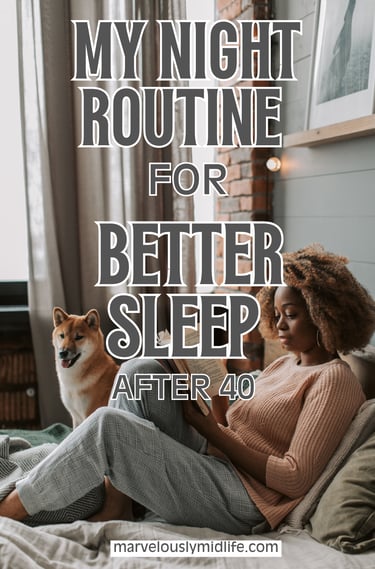
Let’s have a heart-to-heart about the one thing that feels like a total luxury these days: a good night’s sleep. If you’re lying awake at 2:00 AM, staring at the ceiling, wondering why your brain suddenly decided to rehearse a conversation from 2004, you are not alone.
For many of us in midlife, sleep has become this elusive unicorn. We’re "tired but wired," dragging ourselves through the day with an extra shot of espresso only to hit the pillow and feel like we’ve been plugged into a high-voltage outlet. But here is the truth that most "weight loss" gurus won't tell you: you can have the perfect workout and the cleanest diet on the planet, but if you don't have a solid night routine for better sleep, your metabolism is going to stay stuck in the mud.
It’s time to stop treating sleep like a "nice-to-have" and start treating it like the metabolic powerhouse it is. We are going to dive deep into why sleep gets so weird in midlife, why it’s sabotaging your progress, and how to build a sleep routine that actually works.
Why Sleep Becomes a Battlefield in Midlife
This is where things get really real. If you feel like your sleep has been hijacked by a group of tiny, hormonal rebels, you aren’t imagining it. In midlife, your body goes through a biological shift that is just as intense as puberty—only this time, instead of growing pains, we get "wide-awake-at-3-AM" pains.
To build a night routine for better sleep, we have to understand exactly what’s happening under the hood. It’s not just "stress" (though that’s part of it); it’s a complete rewiring of your internal clock. Here is why sleep becomes a total battlefield during this phase of life.
1. The Great Progesterone Disappearing Act
If progesterone had a job title, it would be "The Chief Peace Officer." It’s the hormone responsible for making you feel calm, steady, and—most importantly—sleepy. Progesterone actually converts in the brain to a neurosteroid that hits your GABA receptors. (GABA is the neurotransmitter that acts like the "brakes" for your brain.)
In midlife, progesterone is often the very first hormone to take a dive, usually long before estrogen even thinks about leaving. When your progesterone levels drop, those "brakes" fail. This is why you can feel perfectly fine at 8:00 PM, but the second your head hits the pillow, your brain decides it’s the perfect time to solve the world’s problems or rethink a haircut you had in 1998. Without that natural sedative, your sleep routine has to work twice as hard to get you into a restful state.
2. The Midnight Furnace: Estrogen and the Hypothalamus
We’ve all heard of hot flashes, but let’s talk about what they actually do to your sleep. Your body temperature is regulated by a tiny area in your brain called the hypothalamus. Estrogen acts like a stabilizer for that internal thermostat.
As estrogen levels fluctuate and eventually drop, your "thermoneutral zone" (the range of temperatures where your body feels comfortable) shrinks. Suddenly, a room that felt perfect ten minutes ago feels like the surface of the sun.
When you have a night sweat, your body spikes your heart rate and cortisol to deal with the "heat crisis," which jolts you out of deep sleep and into a light, fragmented state. This is a massive problem if you want to lose weight fast, because you need deep, REM sleep to regulate the hormones that tell your body to burn fat instead of storing it.
3. The Cortisol "Tired but Wired" Trap
Normally, your cortisol (the "go" hormone) follows a beautiful curve: it peaks in the morning to wake you up and slowly tapers off so you can drift away at night. But in midlife, your adrenal glands are often working overtime to pick up the slack for your ovaries.
When you’re stressed, over-caffeinated, or just hormonally imbalanced, your body loses the ability to shut off cortisol production in the evening. This creates that "tired but wired" sensation. You are physically exhausted—your bones feel heavy—but your brain is buzzing with nervous energy. A night routine for better sleep is essential here to manually signal to your adrenals that the "threat" is over and it's safe to power down.
4. The 2 AM Bathroom Trek (The Bladder/Estrogen Link)
This is the one nobody likes to talk about at brunch, but it’s a huge sleep-killer. Estrogen helps maintain the health and elasticity of the tissues in your bladder and urinary tract. As estrogen levels drop, your bladder can become more sensitive, and its capacity can actually decrease.
This leads to "nocturia"—the fancy medical term for having to pee multiple times a night. Every time you get up, you risk waking your brain up fully, making it that much harder to drop back into those deep, fat-burning sleep cycles.
5. The Melatonin Fade
As we age, our pineal gland (the part of the brain that makes melatonin) naturally starts to produce less of the "sleep hormone." Melatonin is what tells every cell in your body that it’s nighttime and it’s time to repair.
When you combine lower melatonin with a slow metabolism, you end up in a cycle where your body isn't repairing itself at night. This leaves you feeling sluggish and "puffy" in the morning. To fire it up and get your body back into a peak state, we have to use our sleep routine to maximize every bit of melatonin we do have left.
6. The "Anxiety Loop" and Perimenopausal Rage
Let’s be honest: sometimes the battlefield is purely emotional. The hormonal shifts in midlife can lead to increased feelings of anxiety, irritability, and even "nighttime ruminations."
This isn't just you "being moody." The drop in estrogen actually affects your serotonin levels (your "happy" chemical). When serotonin is low, your brain becomes much more sensitive to stress. You might find yourself waking up at 3:00 AM with a racing heart, feeling a sense of dread for no apparent reason. This is a physiological response to shifting hormones, and it’s why relaxation tools like sound machines and weighted masks are so vital to fix your sleep and protect your peace.
Why This Battle Matters for Your Weight
If you are trying to lose weight fast, you cannot afford to lose this battle. When your sleep is fragmented:
Your insulin resistance spikes, making it easier to gain weight from "healthy" carbs.
Your growth hormone drops, so you can’t build the muscle needed to fix a slow metabolism.
Your willpower dissolves, making those late-night snacks feel like a necessity rather than a choice.
Building a solid night routine for better sleep isn't just about feeling rested—it’s about giving your body the hormonal environment it needs to finally release the weight and fire it up.
The Missing Link: Why Poor Sleep Stalls Weight Loss
You’ve probably heard me talk about "fire it up" when it comes to your metabolism. Well, sleep is the fuel for that fire. If you aren't sleeping, your internal furnace is basically running on fumes. Here is how poor sleep is directly stalling your progress:
1. The Hunger Hormones: Ghrelin and Leptin
Your body has two main hormones that control your appetite. Ghrelin is the "hunger" hormone (think: G-G-G-Grumbling stomach), and Leptin is the "fullness" hormone.
When you don't sleep: Your Ghrelin levels skyrocket and your Leptin levels plummet.
The Result: You wake up starving, and you stay hungry all day. No amount of willpower can fight a brain that is hormonally programmed to crave sugar and carbs for quick energy.
2. Insulin Resistance
Just one night of poor sleep can make your cells as insulin-resistant as a person with type 2 diabetes for a short period. This means that even if you eat a "perfect" Muscle Mommy meal, your body is more likely to store that energy as fat rather than using it for fuel. If you want to lose weight fast, you have to keep your insulin stable, and that starts in the bedroom.
3. The Muscle-Wasting Trap
During deep sleep, your body releases Growth Hormone. This is the "fountain of youth" hormone that helps repair your muscles and burn fat. If you’re skipping out on deep sleep, your body can’t repair the micro-tears from your strength training. Instead of building lean, toned muscle, your body stays in a "catabolic" state, breaking down muscle and slowing your metabolism even further.
Your Step-by-Step Night Routine for Better Sleep
Ready to reclaim your rest? We are building a sleep routine that addresses the hormones, the temperature, and the mindset. This isn't just about "going to bed early"—it’s about creating a sacred transition from the chaos of the day to the restoration of the night.
Phase 1: The Digital Sunset (90 Minutes Before Bed)
Your brain is incredibly sensitive to blue light. Blue light from your phone, laptop, and TV tells your brain that it’s high noon, which completely shuts down your melatonin production. Melatonin is the "vampire hormone"—it only comes out in the dark.
The Move: Turn off the overhead lights. Switch to lamps with warm, amber bulbs.
The Tech Rule: Put the phone away. If you absolutely must be on a screen, use blue-light-blocking glasses. But honestly, sister? Put the phone in another room. The doom-scrolling is keeping your cortisol high.
Phase 2: The Physical Reset (60 Minutes Before Bed)
This is where we address the temperature and the tension.
The Warm Bath Hack: It sounds counterintuitive, but taking a warm bath or shower about an hour before bed actually helps you cool down. When you get out of the warm water, your body temperature rapidly drops, which is a powerful signal to your brain that it’s time for sleep.
Magnesium Magic: This is my #1 supplement for a night routine for better sleep. Magnesium helps relax your muscles and calm your nervous system.
✨ The Muscle Mommy Sleep Stack: If you're struggling to quiet your mind, I swear by a combination of Magnesium Glycinate and L-Theanine. It’s like a hug for your brain.
PYM Mood Magnesium Powder– This is the exact formula I use to stop the 3 AM brain-chatter.
Phase 3: Creating the Sensory Sanctuary (30 Minutes Before Bed)
Your bedroom should only be for two things: sleep and... well, you know. It should be a sensory sanctuary. If you have a TV in your room, a pile of laundry on the bed, and street lights leaking through the windows, your brain can't fully drop into deep sleep.
Black It Out: Even a tiny bit of light can disrupt your circadian rhythm. You want that room "cave-dark."
Quiet the Noise: Whether it’s a snoring partner or street noise, sound interruptions are a major cause of sleep fragmentation.
🌙 The Sanctuary Essentials:
To truly fire it up the next day, you need uninterrupted rest tonight. These are my non-negotiables:
Light Elimination: I never travel without my silk eye mask. It provides gentle pressure that helps with anxiety while blocking out 100% of light. SilkSound 100% Mulberry Silk Bluetooth Sleep Mask.
Sound Control: If you don't like earplugs, a high-quality white noise machine is a lifesaver. It creates a consistent sound floor that masks sudden noises. We swear by this one to drown out our Shih Tzu's snores. SNOOZ Smart White Noise Sound Machine.
The "Tired but Wired" Relaxation Routine
If you’ve done the physical prep but your brain is still spinning, you need to engage the Vagus Nerve. This is the "kill switch" for stress.
1. The 4-7-8 Breathing Technique
This is a science-backed way to force your body into a "parasympathetic" (rest and digest) state.
Inhale through your nose for 4 seconds.
Hold your breath for 7 seconds.
Exhale slowly through your mouth (making a "whoosh" sound) for 8 seconds.
Repeat this four times. It physically slows your heart rate and signals to your brain that there is no "tiger" chasing you.
2. The Brain Dump
If you’re lying there worrying about tomorrow’s to-do list, get it out of your head. Keep a journal by your bed. Spend three minutes writing down every single thing you’re worried about or need to do. Once it’s on paper, your brain feels "safe" to let it go for the night.
3. Aromatherapy
Scent is the only sense with a direct pathway to the emotional center of your brain. Using a high-quality lavender or cedarwood oil can immediately trigger a relaxation response.
🌿 Relaxation Secret Weapon:
I love using a calm-inducing essential oil roller on my wrists and temples right before I do my breathing exercises.
Calm Essential Oil Blend – This blend is basically peace in a bottle.
What to Do When You Wake Up at 3 AM
We’ve all been there. You wake up, you feel the heat of a hot flash, and then the "worry spiral" starts. "If I don't fall asleep in 10 minutes, I’ll only get 4 hours of sleep, and then I’ll be exhausted for my meeting..."
Stop. The stress of not sleeping is more damaging than the wakefulness itself.
Don't Turn on the Lights: Keep the environment dark.
Don't Check the Time: Checking the clock triggers a math problem in your brain, which wakes you up further.
The 20-Minute Rule: If you aren't back to sleep in 20 minutes, get out of bed. Go to another room, keep the lights low, and do something boring (like reading a physical book—no screens!). Once you feel that heavy "eye-lids" feeling, go back to bed. This prevents your brain from associating your bed with the frustration of being awake.
When you wake up at 3:00 AM, it feels like the world is crashing down. Your brain starts a "greatest hits" reel of everything you're worried about, from your kids' grades to that weird noise your car made three days ago. This is the anxiety loop, and it’s the ultimate enemy of a night routine for better sleep.
When you’re stuck in this loop, your body is pumping out cortisol, which is the total opposite of what you need to lose weight fast. High nighttime cortisol tells your body to store fat and break down muscle. To fix a slow metabolism, we have to kill the anxiety loop before it takes over your night.
Here are the specific, "in-the-trenches" tools to stop the spiral and get you back into that fat-burning deep sleep.
1. The "Physiological Sigh" (The Emergency Brake)
If you wake up with a racing heart or a feeling of dread, you need to engage the Vagus nerve immediately. This is the "kill switch" for your sympathetic nervous system (fight or flight).
How to do it: Take a deep breath in through your nose, then at the very top, take one more tiny "sip" of air to fully expand the air sacs in your lungs. Then, let out a very long, slow exhale through your mouth until you are completely empty.
Why it works: The double-inhale pops open the tiny sacs in your lungs (alveoli), and the long exhale forces your heart rate to slow down. Do this 3 times, and you’ll feel a physical "wave" of calm. It’s the fastest way to fire it up by actually slowing it down.
2. Cognitive Shuffling (The Brain Distraction)
The reason you can’t sleep is that your brain is trying to "solve" problems. Cognitive shuffling forces your brain into "random" mode, which mimics the way we think right before we fall asleep. It stops the analytical loop in its tracks.
How to do it: Pick a neutral word with no emotional baggage, like "BEDTIME."
Start with B: Visualize words starting with B. Bird... Bear... Boat... Button... Stay on B until you run out of images.
Move to E: Elephant... Egg... Envelope...
Move to D: Dolphin... Door... Daisy...
The Secret: Your brain can't be anxious and play this game at the same time. Most women find they are back in a dream-state before they even get to the letter "T."
3. The "Muscle Mommy" Progressive Release
Often, we don't realize how much physical tension we’re holding until we’re wide awake. If your jaw is clenched or your shoulders are at your ears, your brain thinks you’re in a fight.
How to do it: Starting at your toes, squeeze them as tight as you can for 5 seconds, then release and feel them go "heavy" into the mattress. Move to your calves, then your thighs, your glutes, your stomach, your fists, and finally your face.
Why it works: This forces your muscles to physically let go, which sends a signal to your brain that the "danger" is over. It’s a vital part of a sleep routine for anyone dealing with midlife body tension.
4. The "Mental Movie" Visualization
Instead of visualizing your "worst-case scenarios," we are going to use that powerful imagination to build your "Safe Sanctuary."
How to do it: Imagine a place where you feel 100% safe and happy. Maybe it’s a beach at sunset, a cozy cabin, or even your favorite spot in your garden.
Go Deep: Don't just "see" it. What does the air feel like? Is it warm? Can you hear the waves or the wind in the trees? What does it smell like (maybe lavender or salt air)?
The Goal: By engaging all your senses in a positive visualization, you crowd out the anxiety. You are essentially "boring" your brain back to sleep with peace.
5. The "4-7-8" Vagus Nerve Hack
If the physiological sigh didn't quite get you there, the 4-7-8 technique is the gold standard for a night routine for better sleep.
The Count: Inhale for 4, hold for 7, exhale for 8.
The Science: The "hold" allows your oxygen and carbon dioxide levels to rebalance, and the "8-count exhale" is long enough to force your nervous system to switch from "alert" to "rest."
Remember the Golden Rule: Don't Check the Clock! 🛑
The moment you look at the time, you start "the math." “If I fall asleep now, I only get 3 hours and 12 minutes…” This triggers an immediate spike in cortisol.
Keep your phone in another room or face down. If you’re awake, you’re awake. Use your breathing and visualization tools. Even if you don't fall back into a deep sleep immediately, staying in a relaxed, "parasympathetic" state is infinitely better for your slow metabolism than lying there in a panic.
You are teaching your body how to be calm again. It takes practice, but once you master these 3 AM resets, you’ll find that you can lose weight fast because your stress hormones are finally under control.
Consistency is Your Superpower
Building a night routine for better sleep isn't a one-time thing; it’s a practice. Your body loves rhythm. The more consistent you are with your "Digital Sunset" and your "Sensory Sanctuary," the more your brain will start to anticipate sleep the moment you start your routine.
When you master your sleep, you master your metabolism. You’ll wake up with the energy to crush your strength training, the hormonal balance to make healthy food choices, and the mental clarity to show up as the best version of yourself.
You deserve a body that feels rested, strong, and capable. It all starts tonight. Let’s turn down the lights, put away the phone, and fire it up by slowing it down.
Sweet dreams, gorgeous. You’ve got this! 🌙✨
Ready to Build Your Ultimate Sleep Sanctuary?
Don't forget to grab your secret weapons to help you speed up your results:
The Magnesium Stack: [Link]
The Blackout Mask: [Link]
The Sound Machine: [Link]
The Relaxation Oils: [Link]
Connect
Contact
info@marvelouslymidlife.com
© 2025. All rights reserved.
DISCLAIMER: As an Amazon associate and affiliate for other brands, I earn commissions from qualifying purchases.