A Quick Note: I occasionally include affiliate links. As an Amazon Associate, I earn from qualifying purchases at no extra cost to you.
How To Get Six Pack Abs After 50 (Yes, Really!)
Want defined abs after 50? It's 100% possible and here's exactly how. Learn the 3 science-backed steps, the best ab exercises with beginner modifications, and the supplements that make your muscles grow faster.
5/4/202610 min read
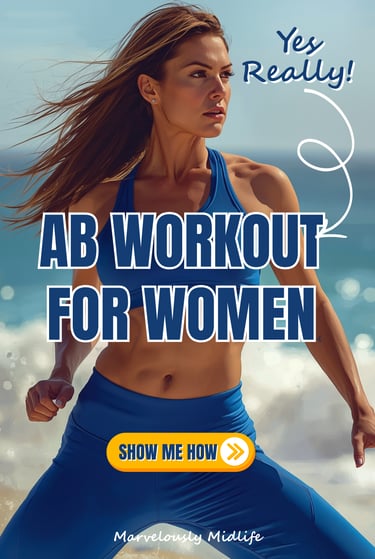
Okay, I need to talk to you about something that I know a lot of us in midlife have quietly given up on: abs. 😅
Like, at some point we just decided that a flat, defined midsection was something for 25-year-olds and fitness models, and we made peace with it. We told ourselves it was "hormones" or "just how it is after kids" or "not really that important anyway."
But here's the thing, it actually IS possible to get a defined, strong core after 50. Not only is it possible, but building a strong core is genuinely one of the best things you can do for your health, your posture, your back pain, and yes, the way you look and feel in your clothes. I'm not here to sell you a fantasy, I'm here to tell you the truth: it takes two things working together, and most women are only doing one of them and wondering why they're not seeing results.
Let's break it all down, because once you understand how this actually works, you're going to feel so much more in control. 💪
First, Let's Talk About Your Abs
Before we dive into what to do, it helps to understand what we're actually working with. Your core isn't just one muscle, it's a whole team of muscles working together, and each one plays a different role in how your midsection looks and functions.
The star of the show is the rectus abdominis. This is the muscle that creates the "six-pack" look, those vertical segments you see on the stomach. It runs from your chest down to your pelvis and is responsible for flexing your spine, which is basically what happens when you do a crunch or a sit-up. You can work it from the top down (bringing your chest toward your pelvis) or from the bottom up (bringing your pelvis toward your chest, like a leg raise).
Then there are your obliques, both external and internal. These live on either side of your rectus abdominis and are actually your largest abdominal muscles. They're responsible for twisting and rotating your trunk, and they're what create that gorgeous definition along the sides of your waist. When you work them well, they give your entire midsection a sculpted, athletic shape, not bulky, just tight and defined.
Finally there's the transverse abdominis, the deepest of all your ab muscles, sitting underneath everything else. You'll never see this one visually, but it is incredibly important. It's your body's built-in corset, maintaining internal stability and pressure so you can move powerfully and safely. A strong transverse abdominis also helps flatten your belly from the inside out, so it's worth paying attention to even though it never gets the credit it deserves.
Okay now that we know the players, let's talk about the game plan. 🙌
The Two Things You Absolutely Need
Here's the truth nobody wants to hear but everybody needs to: having a visible, defined core requires two things working together at the same time.
Number one is body fat. For women, your abs typically start to become visible as you get under around 20% body fat. Below that threshold, the muscle definition you've been building will start to show through. Above it, no matter how many crunches you do, your hard work will stay hidden under a layer of fat. This is not a failure, it's just biology.
Number two is actually building the ab muscles themselves. A lot of women focus entirely on diet to lose belly fat, which is great, but if you haven't built any muscle definition underneath, losing the fat still won't give you the look you're going for. You need both. Fat loss reveals your muscles. Training builds them. Neither one alone gets you there.
The really good news? You can work on both at the same time. And we're going to talk about exactly how.
The Diet (This is Where It All Starts)
I know, I know. You've heard this before. But hear me out because I want to explain WHY this matters so much, not just tell you to "eat less."
You can do ab exercises every single day for months and never see any definition if your body fat is too high. The exercises build the muscle, but fat loss is what makes them visible. And fat loss happens primarily through your nutrition. Not cardio. Not crunches. Nutrition.
Now, I have gone deep on this topic in other posts and I highly recommend you check them out because this piece of the puzzle is too important to skim over.
For waking up a sluggish metabolism and understanding how to actually fuel your body to burn fat instead of store it, go read this one right now:
👉 How to Wake Up Your Metabolism and Finally See Results
It covers the exact nutrition shifts that make your body switch from fat-storing mode to fat-burning mode, and it's a game changer, especially for us in midlife when our hormones are making everything feel harder than it used to be.
And if you suspect your liver might be part of the problem (spoiler: it often is for stubborn belly fat), definitely read this one too:
👉 5 Best Drinks to Detox Your Liver and Speed Up Fat Loss
The short version: high protein, getting your body fat to a place where your muscles can actually show, and being consistent. That's the foundation. Now let's build the house on top of it. 🏗️
Training Your Abs (The Right Way)
Here's where it gets fun. 🎉
The exercises I'm going to share with you are not random. They were selected based on something called EMG data, which stands for electromyographic activity. Basically, researchers have measured which exercises cause the greatest recruitment of muscle fibers in each part of the core. We're not guessing here. These are the exercises that science says are the MOST effective for each muscle group.
And because we're not 25 anymore and our bodies deserve some respect, I'm including beginner modifications for all three. Start where you are, not where you wish you were. Progress is the goal. 💪
Exercise One: Cable Crunches (For Your Six-Pack Muscles)
The research is really clear on this one. Spine flexion exercises produce the highest muscle recruitment in the rectus abdominis, those six-pack muscles, and the cable crunch takes that to the next level because it allows you to add progressive overload, meaning you can increase the resistance over time as you get stronger. This is how muscles actually grow. Doing the same thing forever keeps you exactly where you are.
How to do it:
Attach a rope to the high pulley of a cable machine. Kneel down in front of it and position your hips HIGH. This is really important. Keep your hips locked up and still the entire time. If your hips drop or move during the rep, you're letting your hip flexors take over the work, and we want this coming from your SPINE.
Hold the rope attachment so your hands are about two inches apart on either side of your head. Tuck your chin into your chest. Now crunch down, focusing on getting a deep contraction and maximum spinal flexion. Squeeze at the bottom. Slowly return to the starting position.
Aim for 4 sets of 10-15 reps with about 20 seconds of rest between sets.
Beginner modification: Not quite ready for the cable machine? No worries at all. Start with standard floor crunches, but focus on quality over quantity. Cross your arms over your chest, keep your lower back pressed gently into the mat, and focus on actually curling your spine rather than just jerking your neck up. You can also try a stability ball crunch, draping your lower back over the ball, which gives you a greater range of motion than the floor and really lets you feel that deep contraction. Once you're doing 15-20 reps with good form and feeling strong, move to the cable machine. 😊
Exercise Two: Hanging Leg Raises (For Your Lower Abs)
If cable crunches are great, hanging leg raises are the QUEEN of all ab exercises. The EMG data shows they are the most effective movement for the lower abdominal region, which is often the hardest area to develop and also the area most of us want to see results in the most. You know what I'm talking about. 😅
What makes this exercise so effective is the way the abdominal muscles have to work both ways. As your hips flex and your pelvis tilts backward, your abs contract concentrically (shortening). As you lower your legs back down, they have to work eccentrically (lengthening under control) to manage that movement. That full range of demand is what makes this exercise so powerful.
How to do it:
Hang from a pull-up bar with an overhand grip, hands about shoulder width apart. Now here's the KEY: do not just lift your legs straight out in front of you. That's primarily a hip flexor exercise and your abs will barely do any work. Instead, tuck your pelvis under as you bring your knees up, rolling your tailbone toward the ceiling. Bring your knees toward your chin. Slowly lower without letting your legs swing or using momentum.
Beginner modification: Hanging from a bar with full body weight can be intense, especially if grip strength is a limiting factor. Start with lying leg raises on the floor. Lie flat on your back with your hands underneath your lower back for support. Keep your legs together and slowly raise them to about 45-90 degrees, then lower them back down WITHOUT letting them touch the floor. Focus on that same pelvic tuck. Another great progression is using a captain's chair machine at the gym, which supports your arms and back while you raise your knees. This takes grip strength out of the equation so your abs can do the work. 🙌
Exercise Three: Cable Woodchoppers (For Your Obliques)
Your obliques are what give your waist that sculpted, athletic shape. They work in twisting and rotating motions, and the best way to train them is with exercises that include both lateral flexion and rotation. Enter the cable woodchopper, my personal favorite oblique exercise and the one I think completes the whole aesthetic look we're going for.
How to do it:
Set a cable machine to the highest pulley position and attach a standard handle. Stand sideways to the machine about an arm's length away. Grab the handle with both hands and start with arms extended upward toward the pulley. In one controlled motion, pull the handle down and across your body toward your front knee, rotating your torso and pivoting on your back foot. Keep your arms straight, your back tall, and your core tight the whole time. Return slowly to the starting position.
Do 10 reps on each side. That's one set. Do 4 sets total with 20 seconds rest between sets.
Beginner modification: If cable machines feel intimidating, grab a resistance band and anchor it to a door hinge or a sturdy post at about shoulder height. The movement is identical and resistance bands are gentle enough to start with while still challenging your obliques effectively. You can also do a standing dumbbell side bend to start building that lateral flexion strength. Hold a dumbbell in one hand, stand tall, and slowly lower it down your thigh, then return to standing using your oblique. Keep it slow and controlled. 😊
The Supplements That Help Your Muscles Grow Faster
Okay, this is the section I get SO many questions about and I'm so excited to share because the right supplements genuinely make a difference, especially for women in midlife when our body's natural recovery and muscle-building processes have slowed down a bit.
Let me be clear, supplements do exactly what the name says: they SUPPLEMENT a solid nutrition and training foundation. They are not magic. But when the foundation is solid, these three can absolutely accelerate your results.
Whey Protein
If you are not hitting your protein targets through food alone, and most of us aren't, whey protein is the single most important supplement you can add to your routine. Muscle is built from protein, plain and simple. Your body needs amino acids to repair the muscle tissue you're breaking down in training, and if you're not giving it enough raw material, recovery is slower, muscle growth is slower, and results take longer.
Whey protein is a complete protein, meaning it contains all nine essential amino acids your body can't make on its own. It also has an exceptionally high leucine content, and leucine is the amino acid that most directly triggers muscle protein synthesis, which is the scientific term for your body actually building new muscle tissue. For women over 50, getting enough protein is arguably the most important nutritional habit you can build.
Look for a clean whey protein with minimal added sugar and simple ingredients. A great target is getting 25-30 grams of protein per serving and aiming for a total of 0.7 to 1 gram of protein per pound of body weight daily.
👉 Clean Simple Eats Whey Protein (Clean, Delicious, and Made for Women)
Essential Amino Acids (EAAs)
EAAs are a step beyond protein powder because they deliver the exact building blocks your muscles need in their most direct, bioavailable form. While whey protein has to be digested and broken down before your muscles can use it, EAAs are already in their pure amino acid form and go to work almost immediately.
This makes them especially powerful when taken around your training sessions. Sipping on EAAs during your workout can help reduce muscle breakdown while you're training and support faster recovery afterward. For women in midlife who may already struggle with muscle recovery, this is genuinely a game changer.
They're also a great option on rest days to keep that steady supply of amino acids flowing so your muscles can keep repairing and growing even when you're not in the gym.
👉 Essential Amino Acids Supplement for Muscle Recovery and Growth
Creatine
Creatine might be the most well-researched supplement in the entire fitness world, and it is criminally underused by women. For years it was marketed almost exclusively to bodybuilders, but the research is incredibly clear: creatine benefits everyone who does resistance training, including and especially women over 50.
Here's what it does. Creatine increases your muscles' ability to produce energy during high-effort exercise. This means you can push a little harder, lift a little heavier, do a few more reps before hitting failure. Over time, those extra reps and that extra resistance add up to significantly more muscle growth. More muscle means a higher resting metabolism, better body composition, and yes, better ab definition.
There's also emerging research on creatine's benefits for brain health, bone density, and hormonal balance in post-menopausal women specifically. This is not just a gym supplement. It's a longevity supplement.
The best form is creatine monohydrate. Take 3-5 grams daily with water. You don't need to cycle it or take breaks. Just be consistent. Results become noticeable usually within 2-4 weeks.
I want to be honest with you because I think you deserve straight talk more than you deserve hype.
Getting a defined core after 50 is not something that happens in 30 days. It is also not something that requires perfection. What it requires is being consistent about the right things. Getting your nutrition dialed in so your body fat can come down to a place where your muscles can show. Training your abs with the specific exercises that science says actually work. Fueling your recovery with the right supplements so your body can build the muscle you're asking of it.
None of this is complicated. All of it is doable.
You are not too old. Your metabolism is not broken. Your abs are in there. They just need the right environment to show up. 🙌
Start with one thing this week. Maybe it's adding a daily protein shake. Maybe it's committing to 3 ab sessions per week with these exercises. Maybe it's finally going to read that metabolism post I linked and getting your nutrition working FOR you instead of against you.
One thing. Then another. Then another.
That's how this works. And it works beautifully. ✨
Which exercise are you going to try first? Drop it in the comments below, I'd love to cheer you on! 💪
Connect
Contact
info@marvelouslymidlife.com
© 2025. All rights reserved.
DISCLAIMER: As an Amazon associate and affiliate for other brands, I earn commissions from qualifying purchases.