A Quick Note: I occasionally include affiliate links. As an Amazon Associate, I earn from qualifying purchases at no extra cost to you.
5 Japanese Secrets to Lose Belly Fat (That Have Nothing to Do With Dieting)
Discover 5 Japanese daily habits that target stubborn belly fat after 50, including green tea timing, meal structure, carb portions, and a simple 30-minute walking protocol that works with your hormones, not against them.
4/26/202612 min read
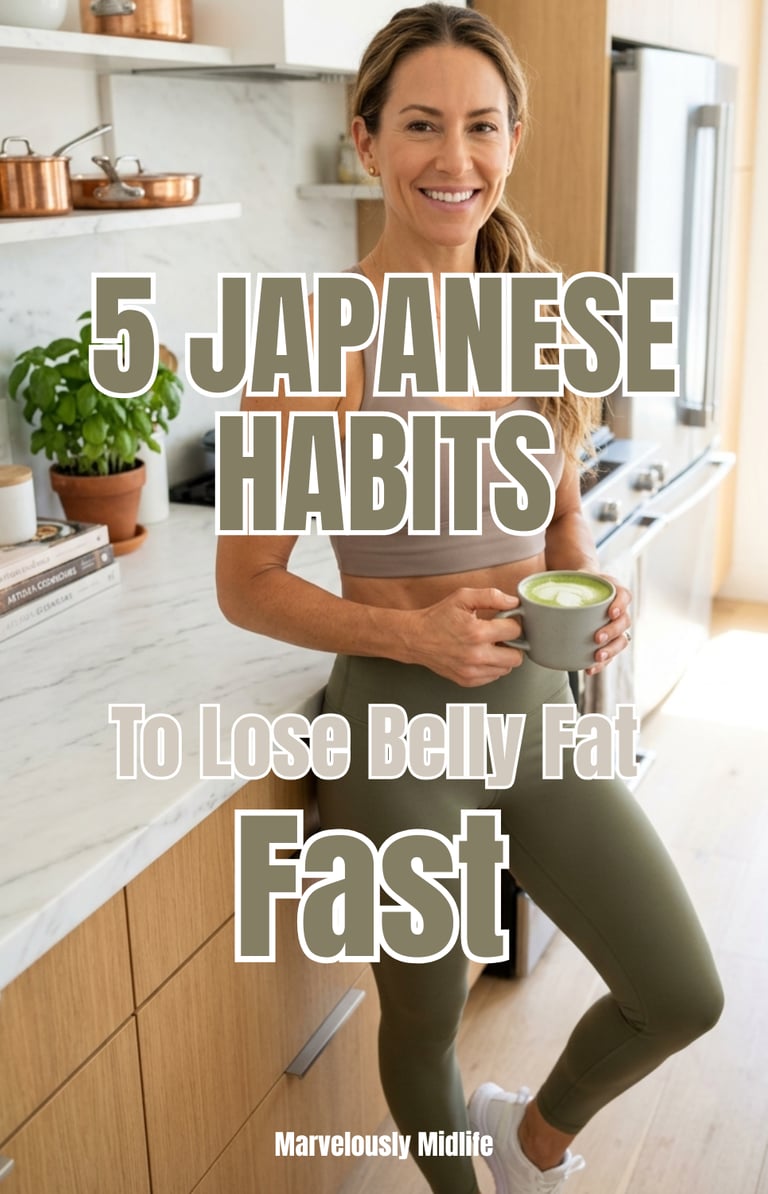
Okay, can we just talk about belly fat for a second? 😤 Not in a "here's your 1,200-calorie meal plan" kind of way. Like an actual real conversation, girlfriend to girlfriend, about why that stubborn midsection pooch seems to laugh in the face of everything we try.
Because here's what nobody tells you: the belly fat that shows up after 50 is a completely different beast. It's called visceral fat, and it sits deep around your organs, not just under the skin. It's hormonally driven, inflammation-fed, and it does NOT respond to the same tricks that worked on us in our 30s. You can be doing everything "right" and this fat just sits there. Honestly so rude. 🙃
Here's the kicker: visceral fat isn't just a cosmetic issue. It's metabolically active, meaning it actually releases inflammatory compounds into your bloodstream on the regular. It's linked to higher risk of heart disease, type 2 diabetes, and hormonal disruption. So losing it isn't just about fitting into your jeans (although, yes, also that). It's genuinely one of the best things you can do for your long-term health.
So when I went down a rabbit hole researching why Japanese women consistently rank among the leanest in the world, well into their 50s, 60s, and beyond, I honestly couldn't stop reading. And the answer is NOT extreme dieting or two-hour gym sessions. It's a handful of daily habits rooted in biology, and they're kind of genius.
Let's get into it. 👇
1. They Drink Green Tea and Matcha Every Single Day 🍵
This is not a "drink green tea to be healthy" generic tip. There's actual fascinating science here, so stick with me for two seconds because once you understand WHY this works, you'll actually want to do it.
Green tea and matcha contain a compound called EGCG (epigallocatechin gallate, in case you want to drop that at your next dinner party 😂). Here's what it does: when your body wants to burn fat, it releases a hormone called norepinephrine that acts like a key, unlocking your fat cells so they can release stored fat into the bloodstream to be burned. Pretty great system, right? Except there's also an enzyme called COMT that swoops in and breaks down that norepinephrine really quickly, basically slamming the door on fat release before it can get going. EGCG blocks that enzyme. It keeps the key in the lock longer, so your fat cells stay open for business.
And here's the part that genuinely blew my mind: visceral belly fat has a significantly higher density of receptors for norepinephrine than the fat just under your skin does. So this mechanism is specifically, disproportionately targeting your belly. Green tea isn't just vaguely good for you. It's biologically targeting the exact fat we're trying to lose. 🤯
The goal is 300-400mg of catechins daily, which looks like:
3-4 cups of Sencha green tea (brewed around 165°F, not boiling or you kill the good stuff) OR 1-2 cups of ceremonial grade matcha whisked with hot water, no sugar, no milk.
A word on timing: having your green tea or matcha about 30 minutes before your walk or workout can amplify the effect, because you're pairing the active EGCG with the norepinephrine spike from exercise. It's like a one-two punch for visceral fat.
My personal hack: I swapped my afternoon coffee for matcha and it completely fixed my 3pm energy crash. No jitters, no crash, just smooth, steady energy that carries me through the rest of the day. If you've never tried it, matcha has a gentler caffeine release than coffee because it also contains an amino acid called L-theanine that takes the edge off. It's calm focus instead of wired anxiety. Total game changer.
For the green tea, I've been loving THIS Sencha Green Tea because quality genuinely matters here for catechin content. Not all green tea is created equal. 🍃
And for matcha, please get ceremonial grade, not the culinary stuff at the grocery store. The difference in EGCG concentration is significant. THIS is the Matcha I Use and Recommend. One scoop whisked into hot water and you feel like a whole different person. ✨
2. Their Plates Are Colorful, Not Beige 🌈
Look at a traditional Japanese meal. It's gorgeous. Deep orange sweet potato, bright green spinach, red peppers, purple eggplant, cherry tomatoes, edamame. Now look at the average American dinner plate. Chicken, pasta, bread, maybe some pale iceberg lettuce. A sea of beige. 😅
Those colorful vegetables are loaded with compounds called carotenoids, things like beta-carotene, lycopene, lutein, and zeaxanthin, and they do something really cool at the cellular level. They neutralize free radicals, which are basically unstable molecules that cause oxidative stress and inflammation in your body. And chronic inflammation? That's one of the primary triggers for visceral fat accumulation, especially after menopause when our estrogen levels drop and our bodies become more inflammation-prone.
But it goes even deeper than that. Carotenoids actually influence gene expression. They can switch on the genes responsible for fat oxidation (burning fat) while dialing DOWN the genes responsible for fat storage. Your actual DNA is responding to the colors on your plate. I know that sounds dramatic but it's just... science. And it's wild. 🧬
Research has found a really clear association between higher carotenoid levels in the blood and lower amounts of visceral fat. This isn't some weak correlation. The data is pretty consistent: the more colorful produce you're eating, the better your body is at clearing out belly fat.
The rule is simple: every single plate should have at least one vibrant color on it. Roasted red peppers, shredded carrots, cherry tomatoes, wilted spinach, roasted beets, sliced avocado, purple cabbage. It doesn't need to be complicated or expensive. Even just adding a handful of cherry tomatoes or some frozen spinach counts.
One non-negotiable thing though: carotenoids are fat-soluble, which means your body literally cannot absorb them without some fat present. If you're eating a salad with fat-free dressing, you may barely be absorbing any of the carotenoids in those vegetables. Always drizzle olive oil over your veggies, add some avocado, or use a dressing with real fat in it. The fat unlocks the benefit.
Speaking of olive oil, it matters what kind you're using. You want extra virgin, cold-pressed, and ideally in a dark bottle to protect the polyphenols (which are their own category of amazing anti-inflammatory compounds). Look for a harvest date on the bottle, that's a sign of a quality producer. If it just says "pure olive oil" or "light olive oil" with no other details, it's been heavily processed and most of the good stuff has been stripped out. This is a Great Olive Oil Worth the Upgrade 🫒
3. Interval Walking Is Their Cardio 🚶♀️
Before you click away because I said walking, just wait. This is not a casual stroll around the block. The Japanese practice something called Interval Walking Training (IWT), and it's specifically structured to target visceral fat in a way that regular, steady-state cardio actually doesn't.
Here's the biology: brisk walking creates a meaningful spike in adrenaline and norepinephrine (there's that fat-unlocking hormone again!). Because visceral fat has a higher density of receptors for these hormones compared to the subcutaneous fat just under your skin, your belly fat responds to this type of movement faster and more directly than other body fat. You are genuinely sending a targeted signal to the problem area.
The reason intervals work better than a steady-paced walk is that each time you ramp up to that brisk pace, you get a fresh hormone spike. Five intervals means five fat-mobilizing surges over the course of 30 minutes. A steady-paced walk at the same overall effort level just doesn't produce the same hormonal response.
The protocol is beautifully simple:
Walk briskly for 3 minutes (like you're late for a flight, you can say a sentence but holding a full conversation would be tough) Stroll easy for 3 minutes (full recovery, breathing comfortably) Repeat 5 times for a total of 30 minutes
Do this 2-5 times a week. Fasted in the morning is ideal if you can swing it, because overnight your insulin levels drop to their lowest point, and low insulin = your body is primed to pull energy from fat stores rather than circulating glucose. Even a 20-minute fasted walk before breakfast can make a meaningful difference.
No gym, no equipment, no expensive membership. Just your neighborhood and 30 minutes. I genuinely love this one because it fits into real life. 💪
4. They Stop Eating at 80% Full (Hara Hachi Bu) 🥢
This one comes from Okinawa, one of the world's famous Blue Zones where people routinely live to 100 in vibrant health. "Hara hachi bu" is an ancient Confucian saying that translates to "eat until you are eight parts full," or roughly 80% full.
Here's the physiological reason this is so powerful: there's a 20-minute lag between food entering your stomach and your brain actually receiving the satiety signal. The hormones that tell your brain "okay, we're full" take time to travel through your system. By the time your brain registers fullness, most of us have already eaten well past what we actually needed. We've all experienced this: you finish dinner feeling totally fine and 20 minutes later you're uncomfortably stuffed. That gap is where we chronically overshoot our caloric needs, research suggests by 20-30%, every single day, without even realizing it.
Over weeks and months and years, that daily overage adds up to a LOT of extra calories getting stored as fat, particularly visceral fat, which your body preferentially fills when you're in a consistent caloric surplus.
Practicing hara hachi bu is really about building habits that create a buffer around that biological delay:
Use a smaller plate (9 inches is the sweet spot; the visual cue of a full plate genuinely signals satisfaction to your brain even if the total food volume is less) Chew every bite 20-30 times (sounds intense until you try it and realize most of us are basically swallowing our food whole 😂) Put your fork down between bites, completely, every time Eat at least one meal a day with no screen: no phone, no TV, nothing. Screen-free eating means your brain actually registers that you're eating, which makes the satiety hormones more effective
What I love about this rule is that it asks nothing of you in terms of restriction. You're not cutting out food groups, you're not logging anything, you're not white-knuckling through hunger. You're just slowing down enough to let your body's own communication system do its job. It's honestly kind of revolutionary after years of diet culture telling us our bodies can't be trusted.
5. They Structure Their Meals Completely Differently 🍱
This is the habit that really shifted my thinking, because it's less about WHAT Japanese women eat and more about HOW they eat, and the physiological effect is significant.
The traditional meal structure is called "ichi-ju san-sai," which translates to "one soup, three sides." A Japanese meal typically starts with a bowl of broth or miso soup, then includes a palm-sized portion of protein, a vegetable side dish, and a small portion of starchy carbohydrate, all served in separate small dishes. Contrast that with how most of us eat: everything piled high on one large plate, often starting by loading up on the carbs first because that's just how we serve ourselves.
And here's a number that honestly stopped me in my tracks when I came across it: the average Japanese meal contains somewhere around 30-40 grams of carbohydrates. The average American meal? Over 100 grams. That's not per day, that's per sitting. 😳 Think about a typical American dinner: a big scoop of pasta or rice, a roll on the side, maybe a sugary sauce. You can blow past 100 grams of carbs before you've even touched your protein. Now think about the ichi-ju san-sai plate: a fist-sized portion of rice alongside fish, miso soup, and vegetables. The carbs are there, they're just not the star of the show.
This matters so much for blood sugar management, especially for us. After 50, our cells become less sensitive to insulin, meaning it takes MORE insulin to process the same amount of glucose than it did in our 30s. When you're eating 100+ grams of carbs in one sitting, you're essentially asking an already-stressed system to handle a flood. The result is a big blood sugar spike, a big insulin surge, and a lot of that excess glucose getting stored directly as visceral fat. Do that three times a day for years and you can see how the belly fat just... accumulates.
Keeping carbs in that 30-40 gram range per meal isn't about cutting carbs out entirely or going keto. It's about right-sizing them the way Japanese cuisine naturally does: a fist of rice, a small sweet potato, half a cup of quinoa. Enough to fuel you, not enough to send your blood sugar on a rollercoaster. Pair that with the meal structure habit of eating your protein and vegetables first, and your blood sugar response becomes even gentler because the fiber and protein slow everything down before the carbs even hit your system. It's a simple shift that adds up to a really big metabolic difference over time. 💡
The reason this structure matters for belly fat comes down to something called gastric emptying, which is the rate at which food moves from your stomach into your small intestine and then into your bloodstream. When you start a meal with soup and then eat protein and fiber before you get to your starchy carbs, you slow that process down significantly. The fiber and protein create a kind of buffer in your digestive system.
Slower gastric emptying means a slower, gentler rise in blood sugar. And a flatter blood sugar curve means a much smaller insulin response. This is huge, because insulin is the hormone that signals your body to store fat. When insulin spikes sharply, your body goes into storage mode, and visceral fat is the primary storage site. When insulin stays low and steady, your body stays in a fat-burning state much longer after eating.
When we pile everything on one plate and eat quickly (especially the carbs first), we get what researchers describe as a "glucose fire hose" effect, a rapid flood of glucose into the bloodstream, a big insulin surge, and your body scrambling to store the excess as fat. For women over 50, this is especially important because our insulin sensitivity decreases with age and declining estrogen levels, meaning we have less tolerance for those glucose spikes than we did in our 30s.
Here's how to adapt this without buying a full set of tiny Japanese dishes (although honestly they're adorable and I might have done exactly that 😄):
Start lunch or dinner with a cup of bone broth, chicken broth, or miso soup before your main meal. Serve your protein, vegetable, and starch on separate sections of your plate rather than mixing everything together Eat your protein and vegetables first, then your starch Keep the starch portion to about the size of your fist
This pairs incredibly well with a high-protein eating style. You're not giving anything up, you're just changing the order and the intention. And your insulin levels will thank you.
A Few More Things the Japanese Do That Are Worth Stealing ✨
Since we're here, a few more habits that contribute to why Japanese women stay lean and healthy well past 50:
They walk constantly as part of daily life, not as formal exercise but just as transportation. Trains, stairs, markets. That low-level, consistent daily movement keeps insulin sensitivity high and metabolism humming without requiring a gym.
They eat fermented foods regularly. Miso, natto, pickled vegetables, certain soy products. Gut health research is now strongly linking the diversity of your gut microbiome with visceral fat levels. An unhealthy gut microbiome is associated with more belly fat and worse metabolic function. Fermented foods are one of the most effective ways to feed your good gut bacteria.
They eat a LOT of fish. Japan has some of the highest per-capita fish consumption in the world. The omega-3 fatty acids in fatty fish like salmon, mackerel, and sardines are powerfully anti-inflammatory, and since chronic inflammation is one of the primary drivers of visceral fat accumulation in midlife women, getting enough omega-3s is genuinely one of the most impactful things you can do.
If fish isn't really your thing, a quality omega-3 supplement fills the gap. Look for one with at least 1,000mg of combined EPA and DHA (those are the two active forms that matter), from a brand that third-party tests for purity and heavy metals. This is the Omega-3 I Trust and Recommend 🐟
They take rest seriously. Chronic stress elevates cortisol, and cortisol directly signals your body to store fat around the midsection. It also increases cravings for high-sugar, high-fat foods, disrupts sleep (which further tanks your metabolism), and breaks down muscle tissue. Stress management isn't a nice-to-have at this stage of life. It is metabolic medicine.
The Big Takeaway 💚
What I love most about the Japanese approach to body composition is how deeply it respects the body's natural rhythms. There's no punishment, no restriction spiral, no "earn your food" mentality. It's a collection of thoughtful daily habits that compound quietly over time into a really different relationship with food, movement, and your body.
For those of us over 50, this philosophy feels like a breath of fresh air. Our bodies have genuinely changed. The hormonal landscape is different, our insulin sensitivity is different, our stress response is different. Strategies that worked in our 30s often don't cut it anymore, and it can be incredibly frustrating when you feel like you're doing everything right and nothing is moving. These habits are designed to work WITH your current biology, not try to override it.
You don't have to implement all five at once. In fact please don't, that's a recipe for overwhelm and giving up by Thursday. 😂 Pick one. The matcha swap tends to be the easiest entry point if you're already a coffee drinker. Or add one colorful vegetable to your dinner tonight. Or try the IWT walk twice this week.
Small, smart habits layered consistently over time are what actually move the needle. And you deserve to feel lean, energized, and strong in this chapter of life. You really do. 💪
Drop a comment and tell me which one you're starting with! And if this resonated, save it and pass it along to a girlfriend who's been fighting belly fat that won't budge. She needs to see this. 👇
Connect
info@marvelouslymidlife.com
© 2025. All rights reserved.
DISCLAIMER: As an Amazon associate and affiliate for other brands, I earn commissions from qualifying purchases.