A Quick Note: I occasionally include affiliate links. As an Amazon Associate, I earn from qualifying purchases at no extra cost to you.
5 Habits That Actually Work to Lose Menopausal Belly Fat
These 5 science-backed habits can help you finally lose menopausal belly fat. From a supplement most doctors never mention to a surprising morning trick, this is what actually moves the needle.
5/17/20269 min read
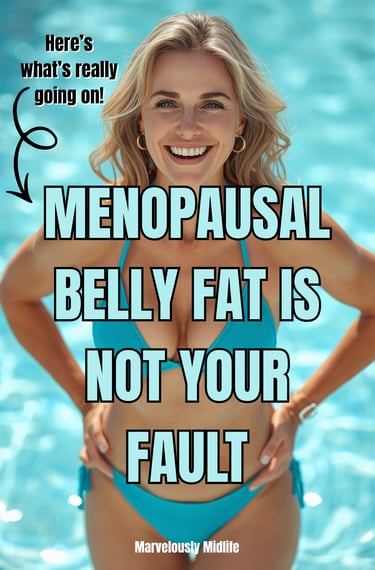
Can we just be honest for a second? Menopausal belly fat is one of the most frustrating things to deal with. You haven't changed what you eat. You're still moving your body. And yet there it is, this stubborn layer around your middle that showed up seemingly out of nowhere and refuses to leave. 😤
If that sounds familiar, I want you to know something important before we go any further. This is not a willpower problem. It is a biology problem. And once you understand what's happening in your body, you can start working with it instead of banging your head against the wall.
The habits I'm sharing today are not your typical "eat less, move more" advice. Some of them you've probably never heard of. All of them are grounded in real research. And together, they can make a real difference for women in perimenopause, menopause, and beyond. Let's get into it. 💪
Why Belly Fat Behaves Differently After Menopause
Before we get to the habits, a quick foundation. Two hormones are driving most of the belly fat struggle after menopause, and it helps to understand both of them.
The first is insulin, which is responsible for taking the energy from your food and directing it where it needs to go, like your muscles, your liver, and your brain. When estrogen drops during menopause, insulin stops working as efficiently. Your cells become more resistant to it, which means more of that food energy ends up stored as fat, and it loves to park itself right around your middle. Visceral fat can actually increase by up to 44% throughout menopause if nothing changes, which is both alarming and motivating at the same time. 👀
The second hormone is cortisol, your stress hormone. When cortisol stays elevated, your body holds onto fat like a survival resource, especially around the belly. High stress, poor sleep, and yes, even overtraining can all keep cortisol elevated and keep that belly fat stubbornly in place.
Both of these hormones are things we can absolutely influence. That's exactly what these five habits do.
Habit 1: The Supplement Most Women Have Never Heard Of
If you've never heard of myo-inositol, you are not alone, and honestly that's kind of the whole problem. This is one of the most underused tools for women's metabolic health and most doctors aren't bringing it up at all.
Myo-inositol is a naturally occurring compound found in small amounts in foods like fruits, beans, and whole grains. But the amounts you get from food are not enough to make a real difference. What we're talking about is a therapeutic supplemental dose that has been studied specifically in postmenopausal women, and the results are genuinely impressive.
In a study of 80 postmenopausal women with metabolic syndrome, participants were given either myo-inositol or a placebo for 12 months. By the end of the study, the myo-inositol group showed significant improvements in blood glucose, insulin resistance, triglycerides, cholesterol, and blood pressure compared to the control group. Even better? Twenty percent of the women in the myo-inositol group no longer met the diagnostic criteria for metabolic syndrome at all, while only one woman in the placebo group saw the same result.
What is it doing exactly? Myo-inositol supports healthy insulin function at the cellular level, which becomes increasingly important as estrogen's protective metabolic effects decline. Beyond that, it also influences serotonin pathways that regulate mood, sleep, and anxiety. So it's not just about belly fat. Better sleep and a more even mood are a very welcome bonus too. 😊
A meta-analysis looking at several randomized controlled trials found that 2 grams twice daily was the most effective form and dosage for weight management. Take it morning and evening with meals. It usually comes as a tasteless powder that dissolves easily in water or coffee, and it costs about $15 a month. This myo-inositol powder is a great option that checks all the boxes. To be effective, take 2 grams (2,000 mg) twice per day. I add it to my EAAs for my morning workout and into my magnesium powder at bedtime.
One important note. If you're on any blood sugar medications, check with your doctor before starting because the effects can stack. This is not a reason to avoid it, just be smart about it. ❤️
Habit 2: It's Not Just How Much Protein You Eat
How much protein are you eating per day? Okay, now how much per meal? Because that second question is where most women are quietly missing something really important.
Your muscle tissue doesn't respond to your daily protein total. It responds to individual meals. Every few hours, your body gets a fresh opportunity to receive the signal to maintain and build muscle. If the protein in that meal falls below a certain threshold, the signal never gets sent.
Research shows the body maximizes muscle protein synthesis with roughly 30 to 40 grams of protein per meal. Eating all of your daily protein in one sitting is far less effective than spreading it across multiple meals.
Here's where menopause makes this even trickier. Something called anabolic resistance, which refers to impaired muscle protein synthesis in response to dietary protein, is associated with advancing age and is worsened by the hormonal changes of menopause. Your muscles become harder to stimulate, so you need more protein per meal to get the same response you used to get with less.
A really common pattern I see is something like this. A light breakfast with yogurt and berries (maybe 12 grams of protein), a salad with some chicken for lunch (around 20 grams), and then a big dinner with salmon or steak (40 to 50 grams). Your daily total might look fine on paper. But the muscle-preserving signal was only triggered once, at dinner. That's not enough to hold onto lean muscle in a postmenopausal body. 😬
Aim for at least 30 grams per meal, ideally closer to 35 to 40. Some easy ways to hit those numbers: 6 ounces of cooked chicken breast, 8 ounces of cooked steak, 10 ounces of white fish like cod or mahi mahi, or two scoops of a quality whey protein. Knowing your per-meal numbers instead of just your daily total is a genuine game changer.
This whey protein is a clean, easy option that makes hitting 35 to 40 grams per meal way less complicated. Two scoops and you're basically there before you've even thought about what else is on the plate.
If dairy doesn't agree with you or you just want something lighter, Essential Amino Acid Powders are worth having in your routine too. They give your muscles the specific amino acids they need to trigger that protein synthesis signal, and they mix easily into water so you can sip them during a workout or between meals. To learn more about EAA Powder, you can read my post How to Build Lean Muscle After 40 Without Extra Calories.
Habit 3: Make Lunch Your Biggest Meal
Okay, real talk. When is your biggest meal of the day? 😏
For most of us it's dinner. You've been running all day, the family's gathered, dinner is the meal you actually get to sit down and enjoy. Completely understandable. But after menopause, that pattern is quietly working against your metabolism.
Your body's ability to process food efficiently is not constant throughout the day. Eating regular meals and stopping food intake after 8 p.m. can help the body metabolize most of its calories during the active part of the day, when insulin sensitivity is at its highest. That sensitivity tends to peak around midday and gradually drops through the evening. The same plate of food hits your body very differently at noon versus 8 p.m.
Before menopause, estrogen helped buffer that evening drop and kept things running more smoothly later in the day. After estrogen declines, that buffer disappears and the evening drop is more dramatic. The dinner your pre-menopausal self handled pretty well is now landing at the worst possible time for your metabolism.
The fix is simple, even if it takes a little getting used to. Shift your biggest, most calorie-dense meal to lunchtime. Keep dinner satisfying but lighter, still with good protein, just lighter on the carbs and overall volume. You're not restricting, just redistributing. Stack this with the protein habit above and you've got a really powerful combo. 🙌
Habit 4: The Weird Morning Trick That Has Two Bonuses
I know how this sounds. Just stay with me for a second. 😂
Every morning before breakfast, fill a large bowl with cold water, drop in a few ice cubes, and submerge your face for a total of 90 seconds. You can break it into smaller dunks, like 30 seconds at a time, coming up for air in between. Once per day is all you need.
The fat-burning reason this works is pretty fascinating. There are two types of fat in your body. White fat is the storage kind, the stuff you're working to lose. Brown fat is metabolically active, meaning it burns energy rather than storing it. Think of it as a built-in fat-burning furnace. The catch is that brown fat activity declines with age and drops significantly after menopause. Cold exposure reactivates it by triggering the release of norepinephrine, which is essentially the "on" switch for brown fat. Your forehead and temples have the highest concentration of cold receptors on your entire body, which is what makes this face dunk so effective without needing a full ice bath or a brutal cold shower at 5 a.m.
But here's the part I love most about this habit. You're going to see it all over TikTok and Instagram right now because the ice water facial is having a serious moment as a beauty trend too, and it turns out the science actually backs it up. Cold water constricts blood vessels momentarily, then triggers a rush of warm blood to the surface of the skin, which boosts circulation and gives skin a healthy, radiant glow. It also tightens pores and reduces puffiness, particularly around the eyes. Influencers and athletes alike swear that cold water immersion can reduce inflammation and make skin glow.
So you're waking up your fat-burning system AND getting a little natural facial glow before your day even starts. Two birds, one bowl of ice water. 🧊✨
One heads-up though: if your skin feels tight, dry, or irritated afterward, dial back the time or temperature a little. The goal is refreshed, not raw.
Do your face dunk, then sit down to a protein-rich breakfast. You're starting the day with your metabolism primed and your skin looking awake.
Habit 5: Walk More Than You Think You Need To
This last habit is less about a single study and more about a pattern that keeps showing up consistently. When daily steps hit the 12,000 to 15,000 range, fat loss starts happening in a way that lower activity levels just don't produce. And the good news is you don't need a gym, good weather, or a free hour to make it happen.
But first, let's talk about what not to do, because this is where a lot of women are accidentally stalling their own results.
If you're grinding through intense cardio and HIIT workouts and wondering why the belly fat isn't budging, cortisol might be your answer. Remember that hormone we talked about at the beginning? Chronically elevated cortisol is linked to increased fat storage around the midsection, and high-intensity exercise can contribute to that spike.
Walking doesn't have that problem. Walking generates far less cortisol than intense exercise, is easier to recover from, and research shows that people who walk as their primary exercise are much more likely to maintain their routine long-term compared to those who rely on high-intensity training. And consistency beats intensity every single time for sustainable fat loss. Walking helps regulate cortisol, which directly influences where your body tends to store fat.
For weight loss specifically, research suggests 12,000 to 15,000 steps per day is the sweet spot, and it can be a genuine game changer for fat loss and metabolic function.
Now here's where I want to share something that has been a total secret weapon for so many women, especially in the winter months or when life gets crazy busy. A walking pad. If you haven't seen one, it's essentially a slim, under-desk treadmill that lets you walk slowly while you're working, watching TV, folding laundry, taking calls, whatever. You can rack up thousands of steps without ever carving out a dedicated workout window. This walking pad is one of the most popular options right now and for good reason. It's quiet, compact, and actually fits under most desks.
A few other ways to boost your step count without it feeling like a chore: walking on an incline can increase calorie burn by 50 to 60 percent compared to flat ground, adding a weighted vest bumps the burn even more, and taking a short walk after meals is particularly helpful for managing blood sugar. Even a 10 to 15-minute post-dinner walk makes a difference.
If 15,000 steps feels impossible right now, start where you are and build. Going from 4,000 to 8,000 steps is a win. Going from 8,000 to 12,000 is another win. Keep stacking them.
Here's what a day that stacks all five habits looks like.
Before breakfast, you dunk your face in ice water for about 90 seconds. Fat-burning system switched on, skin looking fresh and depuffed.
Breakfast is protein-forward, 30 to 40 grams minimum, and you take your first dose of myo-inositol with it.
Lunch is your biggest meal of the day. Most of your carbs, most of your calories, another solid serving of protein. Your body is at its metabolic peak.
Dinner is satisfying but lighter. High protein, lower carb. Your second dose of myo-inositol goes here.
Throughout the day, you're working toward that 12,000 to 15,000 step goal, with your walking pad keeping the movement going even on your busiest days.
That's it. Five habits. No extreme restriction, no brutal workouts, no unrealistic overhauls. Just smarter choices that work with your postmenopausal biology instead of against it. 💕
You haven't been failing, girlfriend. You've just been working with incomplete information. Now you have better information. Go use it.
Connect
Contact
info@marvelouslymidlife.com
© 2025. All rights reserved.
DISCLAIMER: As an Amazon associate and affiliate for other brands, I earn commissions from qualifying purchases.